Skip to content


You're in a hotel room in central Istanbul, still feeling the stiffness from a long flight. The therapist arrives with a mat, asks about your back and hips, and starts with a supported leg stretch that makes your hips feel less locked within minutes. That first change is why Thai massage stretches aren't just a nice add-on for travelers, they're often the most practical way to get your body moving again when you're short on time, space, and patience.
Table of Contents
- What a Thai Stretch Session Actually Feels Like
- How Thai Massage Stretches Differ From Yoga and Standard Stretching
- The Core Stretches You Will Experience in a Session
- What the Research Says About Mobility and Pain Relief
- How to Prepare for a Thai Session in a Hotel Room
- Modifying Stretches for Tight Hips, Stiff Backs, and Limited Range
- Choosing the Right Session Length and Booking With Confidence
What a Thai Stretch Session Actually Feels Like
A proper hotel session doesn't start with a dramatic full-body pull. It begins with the therapist reading your posture on the bed or mat, then easing into the legs because that's where travel stiffness tends to show up first. In a central Istanbul room, the sequence often feels less like being “worked on” and more like your body is being reintroduced to positions it forgot were available.

The first fifteen minutes tell you a lot
The first leg stretch usually resets how the hips feel because it combines support, traction, and a slow opening angle rather than a fast tug. If the room is quiet, clients often notice their breathing drop before the body fully does. That's normal, and it's one reason Thai massage stretches feel different from a standard massage table session.
A seated stretch often arrives earlier than people expect. That shift matters because the therapist is not just chasing one tight muscle, they're changing how the torso and hips organize together.
Practical rule: the stretch should feel like firm assistance, not a contest. If you brace hard against the movement, the session usually gets less useful, not more effective.
The emotional tone is specific too. It's relaxing, but it's not passive in the way a Swedish massage is passive. You're participating with breath, small adjustments, and honest feedback.
For travelers who want to know what a mobile session looks like before they book, a good reference point is this outcall massage experience guide in Istanbul.
How Thai Massage Stretches Differ From Yoga and Standard Stretching
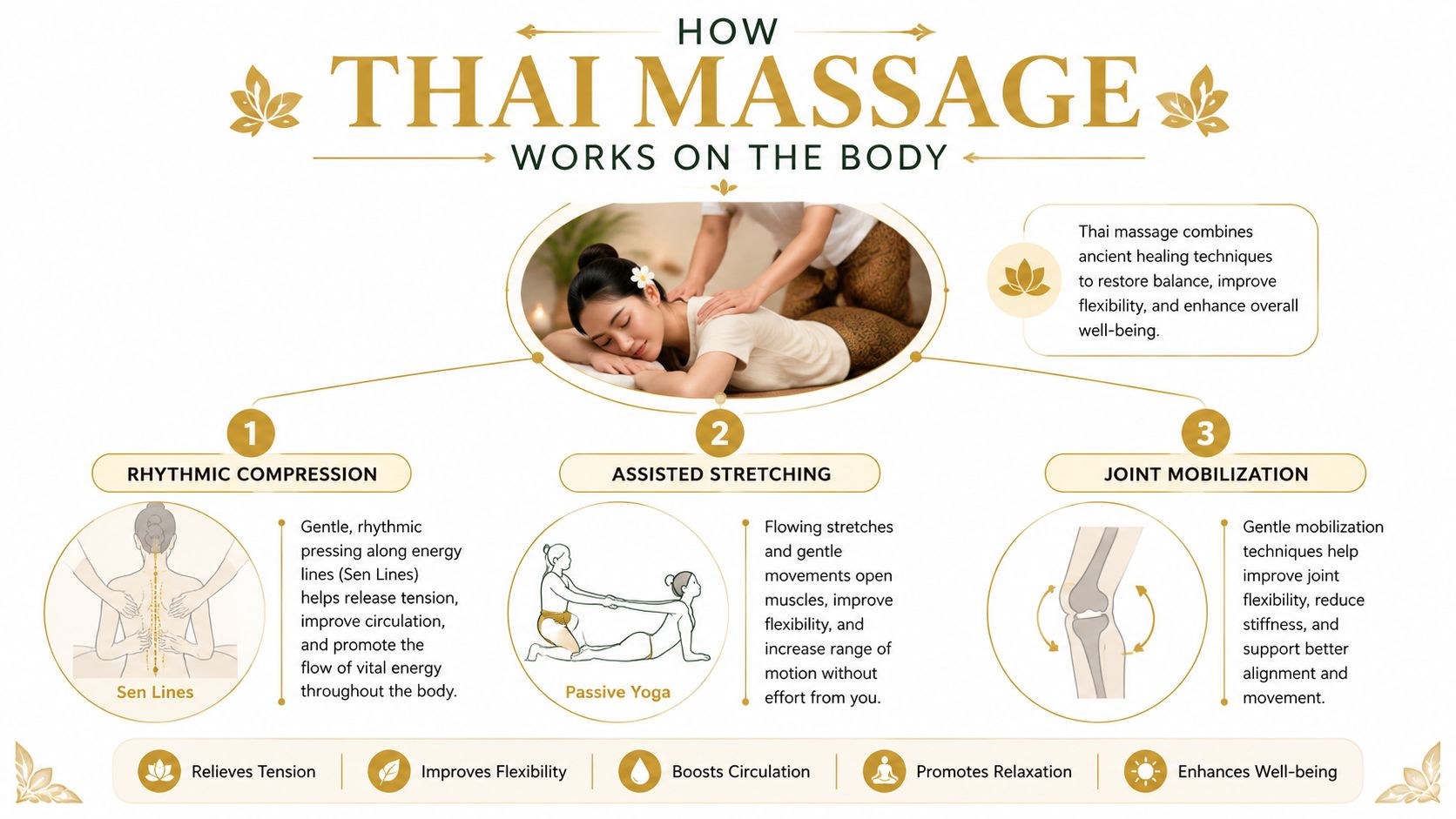
The easiest mistake is to treat Thai work like yoga with another person doing the lifting. That's close, but not accurate. In Thai massage stretches, the therapist controls the rhythm and the angle, so the body can relax into the stretch instead of organizing itself around balance.
Therapist-led leverage changes the result
A yoga pose asks you to hold yourself. A standard stretch asks you to move a muscle toward length. Thai massage asks you to receive movement while another person manages the load, which is why it can feel easier to enter deep positions without fighting for balance. That also means the therapist can combine hands, forearms, elbows, and sometimes feet in a single movement, something you won't get in a yoga class or a simple assisted stretch.

Pressure and movement happen together
The second difference is rhythm. Thai massage blends pressure with motion, so a client may feel compression before a stretch deepens. That sequence matters because the body often tolerates a movement better after the surrounding tissue has been softened by touch.
The third difference is intent. Neutral medical coverage describes Thai massage as passive stretching and yoga poses guided by a therapist, not a workout, and it uses hands, elbows, forearms, and feet rather than oil-based kneading. That distinction helps clients decide whether they want mobility work, relaxation, or both. It also explains why a guide like the safe yoga with back pain resource is useful, because yoga and Thai work may overlap in positions, but the loading, support, and risk profile aren't the same.
A standard massage table session can loosen tissue, but it rarely gives the same joint-opening effect. Thai stretching sits in its own category, somewhere between assisted mobility work, body therapy, and a guided recovery session.
The Core Stretches You Will Experience in a Session
A typical session moves through the body in a predictable order, even if the therapist adapts the depth. The opening sequence usually starts on the back, because that gives the therapist access to the legs, hips, and spine without asking you to stabilize yourself too much. That's the part many hotel clients appreciate most, since jet lag already steals enough coordination.
Legs and hips come first for a reason
The first major movement is often a hamstring or hip opener in supine position. The therapist supports the leg, extends it slowly, and asks you to exhale as the line lengthens. The hold is usually brief, often around 5 to 10 seconds in teaching materials, and the cue is simple, breathe out and let the leg settle rather than pushing against it.
From there, a side-lying stretch changes the angle on the waist and outer hip. A therapist with good control earns trust here, because the movement can either feel spacious or awkward depending on how smoothly the upper body is supported. If you're on a hotel bed, the therapist often uses the surface and your own body weight to keep the motion clean.
The middle of the session opens the spine and shoulders
Spinal twist work usually comes next, and support matters most at this stage. A competent therapist keeps the elbow and forearm padded and uses controlled pressure instead of yanking the torso across the body. Shoulder and arm stretches follow, and they can feel surprisingly relieving if you've been sitting at a laptop or sleeping in an unfamiliar pillow setup.
A prone back extension may appear later, but it should never feel like a forceful arch. The useful version is small, smooth, and guided, not theatrical. The session often closes with a seated forward fold or a seated integration stretch, which pulls the whole line together before you stand up.
The best sessions don't chase flexibility for its own sake. They use just enough stretch to restore movement without making the client feel wrung out afterward.
A full appointment may cover more movements than a casual reader expects, but the body areas stay consistent, hips, hamstrings, waist, spine, shoulders, and arms. If a therapist skips one region, that's usually a sign they're adapting to time, comfort, or your mobility limits, not that the sequence is incomplete.

What the Research Says About Mobility and Pain Relief
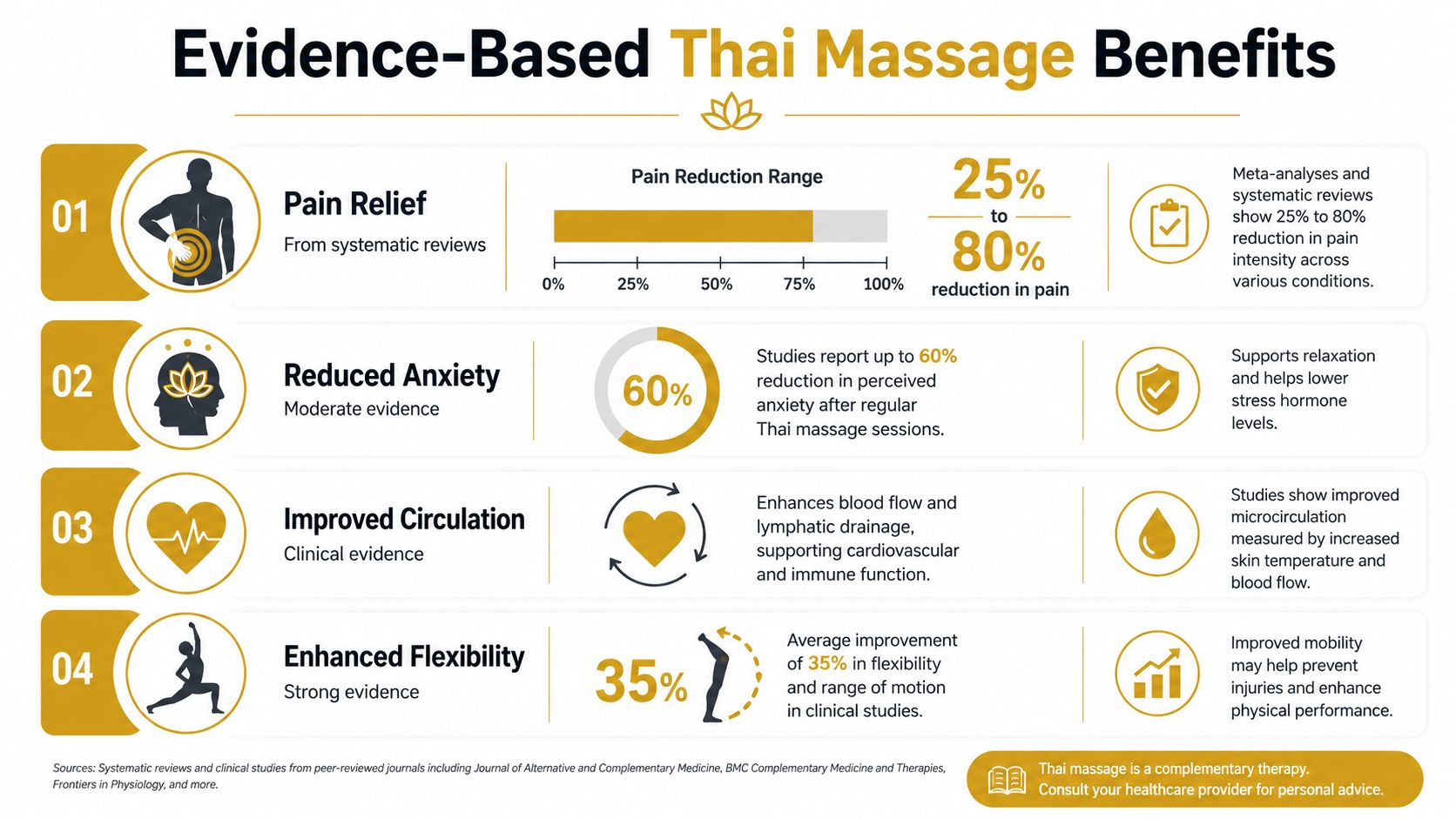
The evidence base is not huge, but it's useful enough to guide expectations. A 2015 systematic review identified 6 controlled studies on traditional Thai massage for chronic pain and reported pre-to-post pain reductions of about 25% to 80%, with benefits also seen for disability, muscle tension, flexibility, and anxiety. Some pain-relief effects lasted up to 15 weeks after treatment, which suggests the gains aren't always gone the next morning. PubMed review
What that means in plain language
For a traveler in a hotel room, the likely win is not instant transformation into a flexible person. The more realistic outcome is easier movement, less guardedness in the hips or lower back, and a body that feels less compressed after sitting, flying, or carrying luggage. That's especially true when the goal is to reduce travel stiffness rather than solve a long-term orthopedic problem.
The stronger clinical signal comes from a randomized trial of 120 hospital outpatients. In that study, traditional Thai massage reduced mean pain scores from 5.3 to 0.51 on a 10-point VAS and disability scores from 24.9 to 8.1 on the ODI after treatment. The traditional Thai massage group's ODI improved by 67.1%, which shows how powerful the stretching-and-pressure format can be in a medical setting. Randomized trial
What to expect from one session versus a short run
One well-timed session can be enough to calm a tight back or loosen a stuck hip, especially after a flight. If the issue has been building for weeks or months, the change from one hotel visit is more likely to be noticeable than permanent. Thai stretching works best when the body gets repeated exposure to the same safe movement patterns.
| What Thai Massage Stretches Have Been Shown to Improve | Reported Range | Where It Helps Most |
|---|---|---|
| Pain reduction | About 25% to 80% across controlled studies | Chronic pain, especially when stiffness and guarding are part of the picture |
| Disability | 67.1% improvement in one randomized trial | Lower-back function and daily movement ease |
| Pain score | From 5.3 to 0.51 on a 10-point scale in one randomized trial | Short-term relief in a medical setting |
| Flexibility and mobility | Improved in controlled studies | Tight hips, hamstrings, shoulders, and spine |
| Anxiety and tension | Reported improvement in the review | Travel stress, nervous system downshift |
How to Prepare for a Thai Session in a Hotel Room
Hotel sessions work best when the room helps the therapist, not hinders them. Loose clothing is essential because the work depends on movement, not oil, and tight waistbands or stiff jeans make the stretches worse before they begin. A room that's warm, quiet, and uncluttered usually produces a better session than a stylish room with no floor space.
Make the room stretch-friendly before the therapist arrives
If the session will happen on the floor, clear enough space for a mat. If the therapist works on the bed, keep the bedding flat and remove extra pillows that get in the way of leg lines and spinal twists. A light towel or blanket helps because clients often cool down once the body starts relaxing into deeper work.

Say the useful things before the first stretch starts
Tell the therapist about sore spots, old injuries, and any joint that doesn't like twisting. Ask for slower transitions if you're stiff, especially in the neck, hips, or lower back. During the session, the cleanest cue is often simple. Say lighter, hold, or pause instead of trying to explain too much mid-stretch.
A first session usually goes better when you don't arrive dehydrated, rushed, or half-dressed in a way that makes the therapist adapt around you. Afterward, give yourself some quiet time rather than diving straight back into a work call or a long walk through the city. The body settles better when the nervous system gets a few minutes to keep the new range of motion.
For practical room setup details, this hotel massage preparation guide for Istanbul is a useful reference.
Modifying Stretches for Tight Hips, Stiff Backs, and Limited Range
The standard Thai sequence is not automatically right for every body. A client with tight hips needs a different approach than a client with joint fear, and someone with a history of back pain often needs less depth, not more enthusiasm. Good Thai work is adaptable, and the therapist should make the stretch smaller before making it more intense.
The safest modifications are usually simple
For a stiff spine, the twist should be shortened and supported, not forced. Supporting the elbow and forearm often keeps the shoulder from loading too hard while the torso rotates. For tight hips, a gentler side-lying stretch can replace a deeper opener that would otherwise pin the low back.
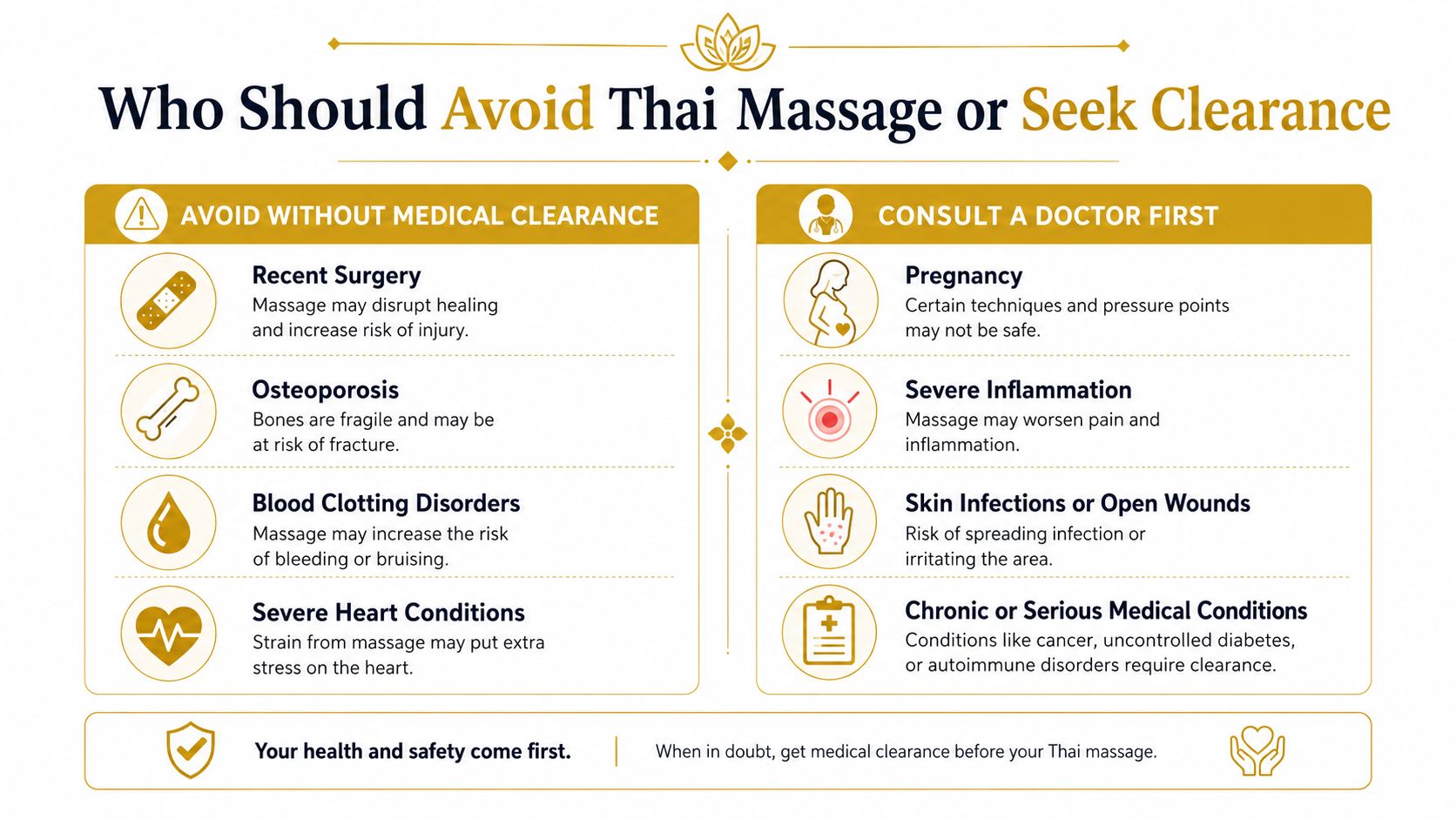
Clients with disc history or nerve sensitivity should be cautious with aggressive backbends. The problem is not the existence of the stretch, it's the amount of compressive load the body has to manage while trying to open. For older adults, hold times should sit at the lower end of the brief range used in teaching materials, and the therapist should move more slowly between positions.
Sharp joint pain, tingling, or a zapping sensation is a stop signal, not a normal part of the process.
The words that help the therapist adjust quickly
Use short feedback instead of waiting too long. If the stretch feels too deep, say it early, not after you've already braced. A therapist can usually change the angle in seconds, but only if you speak up before the body starts guarding.
The same rule applies to pressure. Thai massage combines stretching with traction, so a move can stress both the muscles and the joints at once. That's exactly why the right modification matters, especially for hotel clients who don't know the therapist yet and may be trying Thai work for the first time.
Choosing the Right Session Length and Booking With Confidence
A 60-minute session makes sense when you want a focused stretch sequence for one or two problem areas, especially after a flight or before a business dinner. A 90-minute format is better when you want the fuller rhythm of the protocol and enough time for the therapist to work through the body without rushing the transitions. The longer format is the one that better matches the 25-step structure and 5 position changes described in the standardized protocol. 90-minute vs 60-minute session guide
What to say at booking is simple. Mention any recent injuries, how long your flight was, and whether your goal is pain relief, mobility, or general recovery. If you're unsure, ask for a slower stretch-focused session rather than assuming the therapist will guess your limits correctly.
For hotel guests, that clarity is the difference between a decent massage and a session that changes how your body feels when you stand up. If you know what to expect, the therapist can spend less time correcting and more time doing the work that matters.
Relax Massage Istanbul offers hotel-based Thai sessions in central Istanbul with licensed therapists who work in-room and adapt the stretch sequence to the client's mobility and comfort. If you want a practical session that matches what this guide describes, visit Relax Massage Istanbul and book the format that fits your trip and your body.
Powered by the Outrank tool